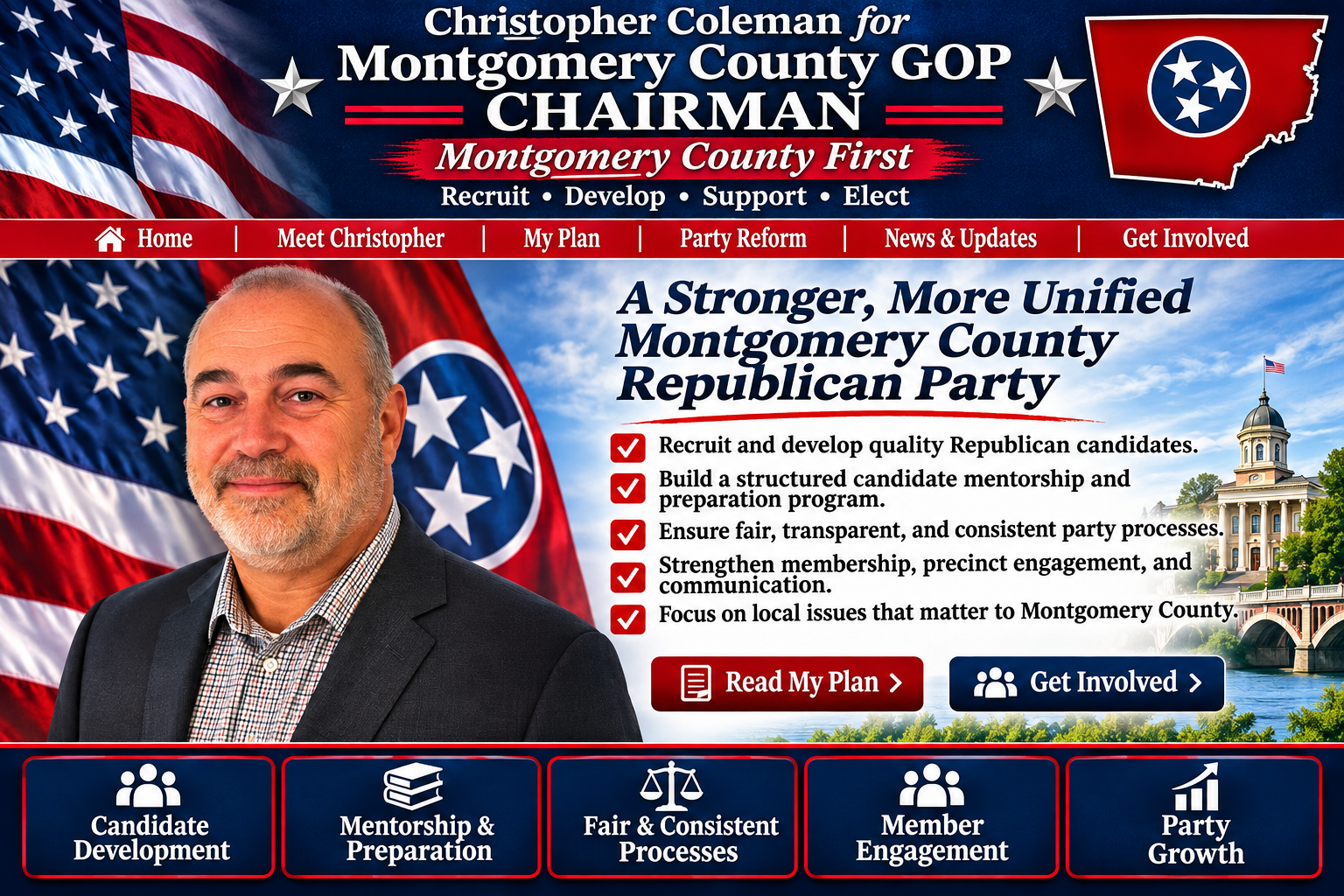
Montgomery County First — Recruit • Develop • Support • Elect
My Plan outlines what I propose to accomplish as chairman. Select a topic below to explore the working plan.
My Vision — Montgomery County First
By Christopher Coleman
With so many active-duty military personnel, military retirees, their families and people working in military-related professions in Montgomery County, it was easy for me to fit into this community. I’ve lived here long enough to watch our community change dramatically. We’ve grown, new neighborhoods have appeared, businesses have opened, and thousands of families have decided to make this county their home. Growth brings opportunities, but it also brings responsibilities.
Roads, schools, public safety, infrastructure, and the cost of living don’t become less important because there’s another argument happening in Washington. Yet somehow, local political conversations repeatedly get pulled into national political battles. I think it’s time we brought the conversation back home.
Local Problems Require Local Solutions
When residents are sitting in traffic on Trenton Road, Warfield Boulevard, or Tiny Town Road, they aren’t particularly interested in hearing another argument about which national politician is responsible for everything wrong in America. They want to know what’s being done about the roads. They want to know who is responsible, what projects are planned, how much funding has been allocated, and when improvements can reasonably be expected.
The same applies to education, public safety, property taxes, and infrastructure. Those questions deserve specific answers. And they require us to understand which level of government actually has the authority to address them.
Some roads are maintained by the state. Others fall under city or county responsibility. Funding may involve multiple agencies and years of planning. If we’re going to hold people accountable, we need to know who is responsible for what.
Stop Confusing Political Loyalty With Performance
I believe in supporting Republican nominees. But that doesn’t mean we should stop evaluating the performance of elected officials simply because they’re Republicans. We should expect them to explain their decisions, justify expenditures, and communicate with the people they represent. And those expectations shouldn’t change depending on which political party holds an office.
Good government is good government. A responsible budget doesn’t become irresponsible because a Democrat proposed it, and a bad decision doesn’t become good simply because a Republican supported it. We ought to be willing to examine the facts and make informed judgments.
Ask Better Questions
Every candidate can tell you what they support. Almost everybody supports better roads, stronger schools, safer neighborhoods, and responsible spending. Those are easy promises to make.
The harder questions are how they intend to accomplish those goals. What authority does the office actually have? What will the proposal cost? Where will the money come from? What are the tradeoffs? How will we measure whether it worked? Those are the questions we should be asking before an election, not two years afterward.
And once someone takes office, we should continue asking them.
Growth Requires Planning
Montgomery County’s growth didn’t happen overnight. We’ve known for years that our population was increasing and that additional development would place greater demands on roads, schools, utilities, and public services. The question isn’t whether growth creates challenges. Of course it does.
The question is whether we’re planning far enough ahead to address those challenges before they become emergencies. Government cannot solve every problem, and taxpayers shouldn’t be expected to fund every proposed solution without scrutiny. But responsible government does require long-term planning, realistic priorities, and the willingness to make difficult decisions.
Simply reacting to the latest complaint isn’t a substitute for having a plan.
Earn the Vote
One of the biggest mistakes any political party can make is assuming voters will support its candidates simply because of party affiliation. People want to know that their concerns are being heard. They want candidates who understand their communities, elected officials who communicate honestly, and political organizations that remain engaged after Election Day.
We should be working to earn that trust every day, not just when somebody needs a vote. For me, Montgomery County First isn’t about ignoring state or national politics. It’s about recognizing that our responsibility begins right here at home.
What was needed? What was promised? What was actually accomplished? Those three questions ought to be part of every discussion about local government. Because at the end of the day, the people of Montgomery County deserve more than political slogans.
They deserve results.
The Plan
Montgomery County First
Purpose: Establish a county-focused organizational approach that recognizes local priorities and the distinct responsibilities of local, state and federal government.
Action Items
- Focus on local roads, traffic, infrastructure, responsible growth and fiscal responsibility.
- Distinguish local, state and federal responsibilities, and the roles of party leadership and elected officials.
- Maintain year-round communication, transparency and accountability.
Desired Outcome: Clearly defined local priorities, consistent communication and organizational accountability.
Membership & Recruitment
Purpose: Review membership procedures, accessibility, participation requirements and relationships with existing Republican organizations.
Action Items
- Assess existing membership processes, requirements and records before implementing changes.
- Identify barriers to participation; provide an accessible online membership application and permanent shareable link.
- Explore online dues payments where applicable and maintain secure membership records.
- Establish clear membership expectations consistent with bylaws.
- Rebuild relationships with former members, including exit interviews where appropriate.
- Maintain existing relationships with local Republican organizations while respecting their independence.
- Establish and strengthen relationships with Republican organizations in surrounding counties to address shared regional concerns, exchange organizational best practices and improve intercounty communication.
Desired Outcome: An accessible, consistent and well-documented membership process with clearly defined organizational relationships.
Precinct Organization
Purpose: Establish clearly defined precinct responsibilities and maintain year-round communication between precinct representatives and party leadership.
Action Items
- Review the precinct captain program and define responsibilities, training and administrative resources.
- Maintain precinct records and continuity books; provide regular opportunities to meet party leadership.
- Identify local businesses, community organizations, neighborhood associations, public events and community facilities.
- Identify venues for public meetings and meet-and-greets; document property-use permissions and applicable signage restrictions.
- Maintain local relationships and communicate community concerns to party leadership.
Desired Outcome: A structured precinct organization with consistent training, recordkeeping, communication and organizational continuity.
Candidate Development & Mentorship
Purpose: Provide prospective candidates with educational opportunities to understand the responsibilities, qualifications and commitments associated with public office.
Action Items
- Establish a formal development and mentorship program, separate from campaign training.
- Provide opportunities to shadow willing elected officials and learn the duties, authority and responsibilities of public office.
- Explain realistic time commitments, workload, meeting attendance, preparation and knowledge requirements.
- Provide opportunities for self-assessment and identify knowledge gaps that can be addressed through education and mentorship.
- Develop budget exercises, mock zoning hearings and practical parliamentary procedure training using Robert’s Rules of Order.
- Create self-paced written and video modules, completion checklists, assessments and certificates.
- Develop continuity books for individual offices and a guide titled So I Want to Run for Office. What Now?
- Document the proposed CEC review process and its authority under governing bylaws, preserving legal eligibility and voters’ choice of nominees.
- Emphasize competence, integrity, accountability and public service.
Desired Outcome: Prospective candidates who can make informed decisions about their readiness and ability to fulfill the responsibilities of elected office.
Supporting paper: So You Want to Run for Office? Do You Know What the Job Is?
Document status: Editorial — pending final review for website publication.
By Christopher Coleman
Every election cycle, we hear the same thing. We need better candidates. We need more people willing to step up and run for office.
I agree.
But I think we’re overlooking something important.
Before we teach someone how to win an election, shouldn’t we make sure they understand the job they’re trying to get?
Running a campaign and serving in public office are two entirely different things.
One requires convincing voters to elect you. The other requires understanding government, making decisions, managing public resources, and representing the people who put you there.
Being good at one doesn’t automatically make you good at the other.
Understanding the Job Before Asking for It Think about someone interested in running for County Commission.
Do they understand how the county budget works? Where the money comes from? Which expenditures are required by law and which are discretionary?
Do they understand zoning, land-use decisions, parliamentary procedure, and the limits of their authority?
Have they ever attended a commission meeting or reviewed an actual agenda?
What about someone running for School Board? Do they understand the distinction between the board’s responsibilities and those of the superintendent? Do they know how education funding works or what decisions the board can legally make?
These aren’t questions we should be asking after someone wins.
They’re questions prospective candidates should be asking themselves before deciding to run.
Candidate Development Should Begin Before Election Season
I’ve proposed developing a candidate mentorship and preparation program within the Montgomery County Republican Party.
Not simply another class on campaign signs, fundraising, or social media.
Those things matter, but they belong in a separate campaign training program.
I’m talking about preparing people for the responsibilities of public office.
We should be identifying potential candidates well before filing deadlines and giving them opportunities to learn what the job actually involves.
That could include shadowing willing elected officials, attending government meetings, studying budgets, and participating in practical exercises.
Imagine giving prospective county commissioners a sample budget and asking them to balance it.
Or presenting a mock zoning case where they must consider property rights, existing regulations, infrastructure, public concerns, and legal requirements before making a decision.
Then have them explain that decision.
Not to embarrass anyone, but to help them understand the responsibilities they’re asking voters to entrust to them.
Leadership Requires More Than Good Intentions I’ve spent a considerable part of my life developing leaders.
One thing I learned during 30 years in the Army is that you don’t wait until someone takes command to begin teaching them what leadership requires.
You prepare them beforehand.
You give them opportunities to learn, make decisions, receive feedback, and understand the consequences of those decisions.
Why should preparing someone for public office be any different?
A candidate development program could include instruction on government structure, ethics, budgets, zoning, public records, constituent services, and parliamentary procedure.
Participants could complete self-paced coursework, practical exercises, and assessments.
We could even recognize those who complete the program.
Not as an endorsement or a guarantee that someone deserves an office, but as evidence that they took the responsibility seriously enough to prepare.
The Party’s Responsibility A political party cannot guarantee that every candidate it supports will become an effective public official.
But it can do more to prepare people before they reach the ballot.
We should also have a straightforward guide titled, “So I Want to Run for Office. What Now?”
That guide should explain qualifications, filing requirements, campaign treasurers, election laws, organizational responsibilities, and the practical steps involved in becoming a candidate.
But that guide should remain separate from learning how to perform the duties of the office.
One teaches someone how to become a candidate.
The other helps prepare someone to become a public servant.
Both are important.
Better Preparation, Better Choices Ultimately, voters decide who deserves to hold public office.
Our responsibility should be to help ensure they have qualified, informed, and prepared candidates from which to choose.
And if someone goes through the program and decides public office isn’t for them, that’s not a failure.
That’s a successful outcome, too.
They may become an effective volunteer, committee member, campaign manager, or community advocate instead.
The goal isn’t simply to put more names on ballots.
It’s to develop people who understand the responsibilities they’re asking to assume.
We need to stop waiting until someone wins an election to find out whether they understand the job.
Let’s start preparing them before they ever ask for our vote.
Candidate Support & Elections
Purpose: Establish consistent procedures governing party responsibilities, candidate responsibilities, resource allocation and election-related compliance.
Action Items
- Define party and individual candidate responsibilities; assess existing support resources.
- Establish consistent standards for access to party resources and provide educational information on filing, financial reporting and compliance.
- Maintain actual impartiality and the appearance of fairness during contested primaries.
- Document authorized support, expectations and accountability; distinguish official actions from personal endorsements.
- Review the proposed Republican Victory Center concept.
Desired Outcome: Clearly defined expectations, fair procedures and documented accountability.
Consolidated Campaign Support & Community Engagement
Purpose: Evaluate opportunities to consolidate administrative and logistical functions, reduce unnecessary duplication and responsibly manage shared resources.
Action Items
- Examine shared administrative and logistical resources, facilities and scheduling.
- Evaluate duplicated expenses and shared expenditure accounting, including printing and postage.
- Maintain transparent resource allocation and financial oversight, campaign finance compliance and individual candidate independence.
- Provide opportunities for residents to meet and ask questions of candidates for relevant countywide, district and municipal offices, with fair participation opportunities.
- Connect expenditure review to fundraising and fiscal stewardship.
Desired Outcome: Improved operational efficiency, reduced unnecessary expenditures and transparent resource management.
Election Analysis & Technology
Purpose: Establish consistent methods for collecting, maintaining and evaluating election data and organizational performance.
Action Items
- Maintain historical election results and precinct-level records.
- Conduct consistent post-election assessments after wins and losses; distinguish documented findings from assumptions.
- Require written lessons-learned reports and preserve institutional knowledge.
- Assess existing software, databases and digital resources; establish measurable organizational objectives.
Desired Outcome: Reliable historical records, documented lessons learned and organizational decisions supported by measurable information rather than assumptions.
Supporting paper: Winning Doesn’t Mean Everything Worked. Losing Doesn’t Mean Everything Failed.
Document status: Editorial — pending final review for website publication.
By Christopher Coleman
Every election cycle, we seem to go through the same routine.
When we win, everybody congratulates themselves on a job well done. Leadership gets praised, strategies get celebrated, and nobody seems particularly interested in examining what could have been done better.
But when we lose, suddenly everybody becomes an expert. We start pointing fingers, questioning decisions, blaming candidates, and looking for someone to hold responsible.
Here’s my question: If everything was done right when we won, why is everything suddenly wrong when we lose?
The truth is, winning doesn’t mean you did everything right, and losing doesn’t mean you did everything wrong.
We need to get better at understanding the difference.
Learning From What We Don’t See During World War II, statistician Abraham Wald helped examine damage to aircraft returning from combat.
The initial thinking was to reinforce the areas showing the most bullet holes.
Wald recognized a problem with that approach. They were only examining the aircraft that made it home. The planes that were hit in critical areas often never returned.
In other words, focusing only on what survived could lead to reinforcing the wrong parts of the aircraft.
That’s called survivorship bias.
And I think there’s a lesson there for how we evaluate elections.
We spend a tremendous amount of time examining the votes that were cast, but how much time do we spend understanding the voters who stayed home?
How many people didn’t participate because they weren’t engaged? How many didn’t know who was running? How many were never contacted or given a reason to get involved?
And just as importantly, what did we do right that we need to preserve?
Look at Montgomery County Our recent elections provide a good example.
Republican participation in Montgomery County remained relatively consistent with previous midterm elections in several comparisons, while Democratic participation increased.
That distinction matters.
If Republican support remained relatively stable but Democratic participation grew, we shouldn’t automatically conclude that Republicans abandoned the party.
We need to examine whether we failed to expand our own participation while the opposition successfully expanded theirs.
We also need to look at candidate recruitment.
Why did we have local races without Republican candidates? Were there opportunities to compete that we simply didn’t pursue? Did we devote our resources to the right races?
These are questions worth answering.
Not because we need someone to blame, but because we need to know what actually happened.
An After-Action Review Isn’t an Exercise in Blame I spent 30 years in the Army, and one thing I learned is that you don’t wait until something goes wrong to evaluate performance.
You conduct an after-action review whether the mission succeeds or fails.
You identify what was supposed to happen, what actually happened, what worked, what didn’t, and what needs to change.
And you document those lessons so the next group doesn’t have to learn everything the hard way.
Why shouldn’t we approach elections the same way?
After every election, win or lose, we ought to produce a written executive summary.
Not a document designed to make leadership look good or to assign blame. An objective evaluation of our performance.
We should be examining candidate recruitment, voter turnout, precinct participation, resource allocation, volunteer engagement, communication, and the effectiveness of our efforts.
Then we should use those findings to make informed decisions.
Don’t Destroy What Works Trying to Fix What Doesn’t One of the biggest mistakes an organization can make after a defeat is changing everything simply because it lost.
That’s no different from reinforcing the wrong parts of those returning aircraft.
We need to identify what failed, preserve what succeeded, and make adjustments based on evidence rather than emotion.
And when we win, we need to have the discipline to conduct that same evaluation.
Because a victory can hide problems just as easily as a defeat can exaggerate them.
Moving Forward Montgomery County doesn’t need another two years of finger-pointing and arguing over who deserves the blame.
We need to understand our performance, learn from our mistakes, and build on our successes.
That requires leadership willing to ask difficult questions and accept uncomfortable answers.
Winning doesn’t prove we did everything right. Losing doesn’t prove we did everything wrong.
It’s time we started conducting meaningful post-election reviews, documenting the lessons learned, and actually using that information to improve.
Because the purpose of an after-action review isn’t to rewrite yesterday.
It’s to make sure we’re better prepared for tomorrow.
Communication & Accessibility
Purpose: Improve organizational accessibility through personal interaction, geographically accessible meetings and appropriate modern technology.
Action Items
- Establish two hours of scheduled chairman office hours each week.
- Provide opportunities for members to meet party leadership.
- Hold informal social gatherings and meetings throughout Montgomery County, reducing travel requirements.
- Explore remote participation through Zoom, Discord and other appropriate platforms, consistent with bylaws.
- Keep pace with technological advances to improve communication, accessibility and organizational efficiency.
- Improve website, email, newsletter and social media communication; maintain an accessible events calendar and governing documents.
- Encourage respectful discussion and constructive feedback.
- Encourage elected officials to remain visible and accessible throughout their terms, including town halls and public forums.
- Maintain a directory of official contact information and opportunities for constituents to ask questions.
- Respect elected officials’ independent responsibilities to all constituents.
Desired Outcome: Reliable communication channels, accessible organizational information and regular opportunities for interaction with leadership and elected officials.
Supporting paper: Political Parties Don’t Govern. Elected Officials Do.
Document status: Editorial — pending final review for website publication.
By Christopher Coleman
There’s something I think we need to clear up about the responsibilities of political parties and elected officials.
They’re not the same thing.
We often hear people criticize the Republican Party for decisions made by elected officials. Sometimes those criticisms are justified when the party has actively supported a particular policy or decision.
But we need to understand where the party’s responsibilities end and where an elected official’s responsibilities begin.
Because if we’re going to demand accountability, we need to hold the right people accountable for the right things.
What Is the Party Supposed to Do? The responsibility of a county political party is relatively straightforward.
Recruit qualified candidates. Develop and prepare them. Organize volunteers. Communicate with voters. Support nominees. Help elect Republicans to public office.
That requires leadership, planning, fundraising, organization, and community engagement.
The party should also provide opportunities for members to discuss issues, express concerns, and communicate with their elected representatives.
But the party chairman doesn’t get a vote on the County Commission simply because he’s chairman.
The party doesn’t approve the county budget, direct the school superintendent, or determine which roads receive state funding.
Those responsibilities belong to the appropriate elected officials and government agencies.
Elected Officials Have a Different Responsibility Once someone is elected, their responsibilities change.
They aren’t simply representing the people who voted for them.
They’re representing everyone within their jurisdiction.
That includes Republicans, Democrats, independents, and people who didn’t vote at all.
Their decisions must be made within the legal authority of their office, not according to instructions from a political party.
A county commissioner must consider the interests of the county. A school board member must fulfill the responsibilities established for that office. A state representative must represent the people of the district.
Political affiliation may influence their principles and policy priorities, but it doesn’t eliminate their obligation to govern responsibly.
Influence Is Not Control Does that mean the Republican Party should remain silent when elected Republicans make questionable decisions?
Absolutely not.
The party should maintain relationships with elected officials, communicate concerns, encourage transparency, and provide opportunities for members to ask questions.
When an issue arises, we should be willing to discuss it openly.
But there’s a difference between influencing a decision and having the legal authority to make it.
We should never promise voters that the party can accomplish something that only an elected governing body has the authority to do.
That creates unrealistic expectations and confusion about accountability.
And frankly, it lets the people who actually make the decisions avoid answering for them.
Accountability Goes Both Ways The party should be accountable for how well it recruits candidates, organizes volunteers, communicates with members, manages resources, and supports elections.
Elected officials should be accountable for their votes, decisions, budgets, conduct, and performance in office.
Those responsibilities may overlap, but they shouldn’t be confused.
If the party fails to recruit a candidate for an important race, that’s an organizational failure worth examining.
If an elected official votes for a questionable expenditure, that official should explain the decision.
If communication between the party and elected officials breaks down, both sides should work to improve it.
But accountability only works when responsibilities are clearly defined.
Working Together Without Confusing Roles An effective Republican Party should have strong relationships with its elected officials.
Not relationships built around personal loyalty or unquestioning agreement, but around communication, mutual respect, and shared principles.
We should be able to disagree without treating every disagreement as betrayal.
We should be able to ask difficult questions without turning them into personal attacks.
And elected officials should be willing to explain their decisions without expecting the party to defend everything they do.
That’s how responsible organizations operate.
Know Who Is Responsible If we want better government in Montgomery County, we need an informed electorate that understands how government works.
We need candidates who understand their responsibilities, party leaders who understand theirs, and voters who know where to direct their questions.
A political party can help elect good people.
It can support them, communicate with them, and encourage them to uphold the principles they campaigned on.
But it cannot govern in their place.
The party’s job is to recruit, develop, support, and elect.
The elected official’s job is to govern and represent the people.
Understanding that difference is the first step toward meaningful accountability.
Community Engagement
Purpose: Maintain consistent community involvement through public interaction, educational opportunities and community service.
Action Items
- Maintain a year-round community presence and listen to local concerns.
- Provide community service and educational opportunities.
- Develop a lending library with a checkout system and materials on government, history, economics and civic responsibilities.
- Maintain relationships with local organizations.
Desired Outcome: Established community relationships, accessible educational resources and a sustained organizational presence throughout the year.
Fundraising & Fiscal Stewardship
Purpose: Directly connect fundraising objectives to organizational requirements, responsible budgeting and approved expenditures.
Action Items
- Assess existing fundraising practices and financial commitments; establish defined objectives and budgets.
- Connect fundraising objectives to approved expenditures and evaluate financial efficiency, including duplicated costs.
- Maintain responsible budgeting, financial reporting, cost allocation and transparency.
- Review expenditures and financial effectiveness after election cycles; preserve accurate records and continuity.
Desired Outcome: Transparent financial management, measurable expenditure effectiveness and responsible stewardship of organizational funds.
Clean Campaigns & Party Unity
Purpose: Establish consistent expectations for professional conduct, impartiality, accountability and the resolution of internal disagreements.
Action Items
- Establish consistent professional conduct standards and encourage factual, issue-focused discussion.
- Distinguish legitimate scrutiny from personal attacks; apply rules fairly and consistently.
- Maintain actual impartiality and the appearance of fairness; document official decisions.
- Distinguish personal opinions and endorsements from official actions.
- Establish procedures for resolving disagreements and hold leadership to the same standards as members.
Desired Outcome: Clearly understood standards that are applied fairly and consistently to members, candidates and leadership.
Supporting paper: Why Conservatives Need an Effective Republican Party
Document status: Editorial — pending final review for website publication.
By Christopher Coleman
I’ve been a Republican my entire adult life, and I’ve watched the party change over the years. Some changes have been good. Others have left me wondering whether we’ve lost sight of what a political party is supposed to accomplish.
We spend a tremendous amount of time debating what it means to be a conservative. We argue about who is conservative enough, who supports the right people, and who deserves to call themselves a Republican.
Meanwhile, we sometimes overlook something far more important.
What are we actually accomplishing?
Principles Need an Organization Conservative principles don’t accomplish much sitting on a bumper sticker or being repeated on social media.
If we believe in fiscal responsibility, constitutional government, individual liberty, and accountable leadership, we need an organization capable of advancing those principles.
That’s where the Republican Party comes in.
A political party isn’t supposed to be a social club, a collection of competing personalities, or a platform for settling personal disagreements.
Its purpose is to organize people around shared principles, recruit qualified candidates, prepare them for public office, support them through elections, and give voters a reason to participate.
That takes planning, organization, and leadership.
It also takes people willing to put the mission ahead of their personal preferences.
Primaries Are for Competition Republican primaries are where voters decide who will represent the party.
Candidates should be free to compete, explain their positions, challenge one another’s ideas, and make their case to Republican voters.
The party organization should establish fair procedures and provide equal opportunities without allowing official positions or party resources to become tools for favoring particular candidates.
Individual Republicans are entitled to their preferences. Party officials, however, have an additional responsibility to protect the fairness and credibility of the process when acting on behalf of the organization.
Once voters make their decision, we need to respect it.
You don’t have to agree with every position a nominee holds. You don’t have to pretend your preferred candidate was never your first choice.
But if we expect voters to trust our primary process, we ought to respect the outcome ourselves.
Primaries are for competition. General elections are for winning.
Winning Elections Isn’t the Entire Mission Winning matters. That’s why political parties exist.
But what happens between elections is just as important.
Are we developing future candidates? Are we preparing volunteers? Are we maintaining relationships with voters? Are we communicating with our elected officials? Are we helping residents understand the issues affecting their communities?
Or are we waiting until filing deadlines approach before scrambling to find someone willing to put their name on a ballot?
A successful political organization doesn’t begin preparing for the next election after the current one ends.
It should already be preparing.
That means identifying potential candidates early, helping them understand the responsibilities of public office, and developing an organization capable of supporting them.
It means having a plan that survives changes in leadership.
Accountability Starts at Home We cannot demand transparency and accountability from elected officials while refusing to apply those same standards to our own organization.
Members should understand how decisions are made, how resources are allocated, and what their leadership is working to accomplish.
Rules should be clear, consistently applied, and accessible to the people expected to follow them.
Disagreements should be addressed through established procedures rather than personal relationships or selective enforcement.
And when something doesn’t work, we should be willing to acknowledge it and make corrections.
That’s not weakness. That’s responsible leadership.
Montgomery County First National politics will always influence local elections, but Washington doesn’t fill potholes on our county roads, manage our local schools, or make every decision affecting our community.
Those responsibilities belong to the appropriate local and state officials.
Our county party needs to understand those distinctions and focus on the issues that matter here at home.
We need to recruit, develop, support, and elect candidates who understand the offices they’re seeking and the people they hope to represent.
We need to earn support rather than assume voters owe it to us because there’s an R next to someone’s name.
And we need to build an organization where people are encouraged to participate, contribute ideas, and take ownership of its success.
Conservative principles matter. But principles without organization, preparation, and action are little more than talking points.
It’s time we focused less on proving who the better Republican is and more on building a Republican Party capable of doing its job.
Montgomery County Republican Party Platform
Purpose: Establish a formal process for developing, reviewing and adopting a county-specific platform addressing local policy issues.
Action Items
- Determine whether a formally adopted county platform exists and review prior resolutions and positions.
- Use the proposed local policy areas as a starting point for discussion: fiscal responsibility, infrastructure, responsible growth, public safety, education, economic development and government accountability.
- Solicit membership input and present proposals for discussion and formal adoption under applicable rules.
- Publish any adopted platform and review it periodically; respect the independent governing responsibilities of elected officials.
Desired Outcome: A formally considered, accessible and periodically reviewed county party platform that respects the independent responsibilities of elected officials.
My First 100 Days
Purpose: Conduct a comprehensive organizational assessment before implementing significant changes, identifying what currently works, what needs improvement and what is missing.
Action Items
- Focus areas, in no particular order: membership and recruitment; finances and fundraising; committee structure and responsibilities; precinct organization; candidate development and support; communications and technology; community engagement; bylaws and internal policies; recordkeeping and organizational continuity.
- Assess existing systems to determine priorities, timelines, resources and implementation requirements.
- Identify → Evaluate → Retain → Improve → Develop → Integrate.
- Establish clear objectives, responsibilities, timelines and measurable standards.
Desired Outcome: An informed implementation plan with established priorities, assigned responsibilities, realistic timelines and measurable objectives.